

Valves are everywhere in irrigation systems, but not every valve is designed for the same job.
Farmers, installers, and irrigation project managers often see terms like ball valve, gate valve, and solenoid valve. They all control water, but they work differently and fit different situations.
Choosing the right valve can affect water flow, maintenance, automation, and long-term reliability.

pic.1 Different irrigation valves
A ball valve uses a rotating ball with a hole through it. When the hole lines up with the pipe, water flows. When the ball turns 90 degrees, the valve closes.
Ball valves are popular because they are simple, strong, and quick to open or close.
Common advantages:
fast on/off control
good sealing
simple structure
durable in many water systems
suitable for manual or electric control
In irrigation, ball valves are often used where reliable shutoff is needed. They can also be used with electric actuators or smart valve controllers for automatic irrigation control.
A motorized or smart irrigation ball valve can be useful when the farm wants remote on/off control instead of manual operation.

pic.2 Ball valve
A gate valve uses a gate-like plate that moves up and down to open or close water flow.
Gate valves are often used in larger pipelines and industrial water systems. They are usually better for full-open or full-close operation, not frequent switching.
Common advantages:
low flow resistance when fully open
suitable for larger pipe systems
familiar in many water supply applications
However, gate valves are usually slower to operate than ball valves. They are not always the best choice for frequent automatic switching in irrigation zones.
For farms, a gate valve may be used in main pipelines, but it is less common as the main smart control valve for repeated irrigation schedules.

pic.3 Gate valve
A solenoid valve uses an electromagnetic coil to open or close the valve. It is very common in sprinkler systems, gardens, and smaller irrigation control systems.
Common advantages:
easy to control electrically
widely used with irrigation controllers
suitable for automatic scheduling
fast response
Solenoid valves are often used in landscape irrigation and smaller sprinkler zones. They usually need stable electrical control and may be more sensitive to water quality, pressure, or clogging depending on the design.
For farmland irrigation, the choice between solenoid valves and motorized valves depends on pipe size, power supply, pressure, water quality, and maintenance conditions.
There is no one best valve for every system.
Ball valves are strong and reliable for on/off control. When combined with a smart actuator or controller, they can become smart irrigation valves for farms, orchards, and remote fields.
Gate valves are useful in some main pipeline applications, but they are usually not the first choice for frequent automatic zone control.
Solenoid valves are common in sprinkler and landscape systems, especially where wired controllers are already installed.
For agricultural IoT irrigation, many projects prefer smart ball valve or electric valve solutions because they can be designed with solar power, LoRaWAN, 4G, or remote control.
Choose a ball valve if:
you need reliable on/off control
the valve may be automated with an actuator
the system needs strong sealing
the irrigation point is in farmland or outdoor conditions
Choose a gate valve if:
it is for a main pipeline
it will stay mostly open or mostly closed
frequent automatic switching is not required
Choose a solenoid valve if:
it is a sprinkler or landscape irrigation zone
the system already has a compatible controller
electrical power and water quality are suitable
When irrigation becomes smart, the valve is only one part of the system.
The farm also needs to consider:
power supply
controller type
communication method
waterproof protection
manual override
maintenance access
app or cloud platform
A simple valve becomes much more useful when it can be controlled remotely and scheduled automatically.
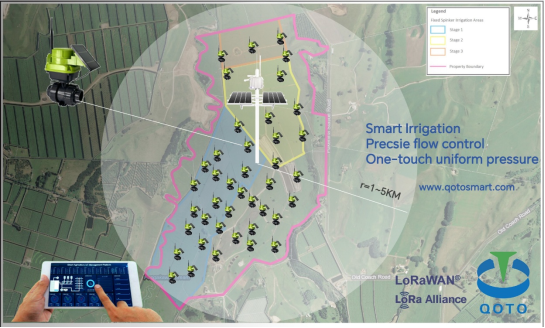
pic.4 Irrigation automation
Ball valves, gate valves, and solenoid valves all have a place in irrigation. The best choice depends on how the valve will be used.
For modern farm irrigation, the trend is moving toward automatic and wireless control. That is why smart irrigation valves, LoRaWAN valve controllers, 4G irrigation valves, and solar-powered valve systems are becoming more common in agricultural water management.